
2019 closed out a “lost decade” for the world’s tropical forests, with surging deforestation from Brazil to the Congo Basin, environmental policy roll-backs, assaults on environmental defenders, abandoned conservation commitments, and fires burning through rainforests on four continents. The following covers some of the biggest rainforest storylines for the year. MORE
Category: Mongabay Features
The 2010s were a tumultuous time for tropical forests. The decade opened with hope and optimism built on solid momentum around recognizing the value of forests and their inhabitants, technological advances that increased transparency, empowered activists and communities, a new breed of corporate conservation commitment, and unprecedented progress in reducing deforestation in Earth’s largest rainforest. [Continue reading]
Whether it was radio-collaring elephants across the savannas of South Africa, competing internationally alongside the Israeli national team in tennis, tracking saki monkeys through the rainforest in the sweltering mid-day heat of the Peruvian Amazon, or evaluating the practicalities of implementing technological solutions to conservation challenges, Sue Palminteri fully embraced all she pursued with rare [Continue reading]
I understand the desire to correct misinformation that proliferates in the aftermath of breaking news events. And I understand the frustration of sensationalist headlines that mislead readers. But columnist Michael Shellenberger’s attempt in Forbes to correct the record on fires burning in the Brazilian Amazon was sloppy at best, and deceiving at worst. Shellenberger is right on several [Continue reading]
Brazilian President Jair Bolsonaro likes to assert that foreigners deserve no say over the fate of the Amazon because it is a national sovereignty issue. His logic: Brazilian Amazon is Brazil’s sovereign territory and therefore it has the right to do what it wants with it, whether that be clearing it for cattle pasture and [Continue reading]
The dry forest of western Madagascar is famous for its wildlife and baobab trees, including the tourist destinations of Baobab Alley, Tsingy de Bemaraha, and Kirindy Forest. Among the species that call these forests home are the rabbit-sized giant jumping rat (Hypogeomys antimena); the puma-like fossa (Cryptoprocta ferox), Madagascar’s largest predator, which feasts on lemurs; [Continue reading]
Borneo has been special to me since my earliest years. As a kid, I would voraciously read books about the wilds of Borneo, with its dense rainforests inhabited by traditional indigenous peoples and wondrous animals like orangutans, clouded leopards, and pygmy elephants. As I grew older, I became aware of the environmental devastation in Borneo. [Continue reading]
2018 wasn’t a great year for tropical rainforests, with major conservation setbacks in Brazil, Democratic Republic of Congo, Madagascar, and the United States coming on top of back-to-back years of high forest cover loss. Here are ten storylines we’re watching in the world of rainforests as we begin 2019.
Categories
Mongabay’s origin story
One of the few benefits of having a father who had to fly each week from San Francisco to meet clients in Hawaii and Alaska during my formative years was the airline miles — my father had a ton. So many, in fact, that our family didn’t have to spend a lot of money on [Continue reading]
It’s easy to be pessimistic about the state of the world’s forests. Rates of forest loss remain persistently high, especially in the tropics and boreal regions. Drought, fragmentation, degradation via logging, and climate change are conspiring to make forests more vulnerable to fire: vast areas of forest went up in smoke across Canada, Russia, the [Continue reading]
Between Indonesia’s massive forest fires, the official approval of REDD+ at climate talks in Paris, and the establishment of several major national parks, there was plenty to get excited about in the world of rainforests during 2015. What’s in store for 2016? MORE
Categories
The year in rainforests: 2015
Between the landmark climate agreement signed in Paris in December 2015, Indonesia’s fire and haze crisis of the late summer and early fall, and continuing adoption of zero deforestation policies by some of the world’s largest companies, tropical forests grabbed the spotlight more than usual in 2015. Here’s a look at some of the biggest [Continue reading]
Since early 2014, prices for most commodities produced in the tropics have plunged. Palm oil is down by 40 percent, logs from Malaysia and Cameroon are off by roughly a fifth, while soybeans have fallen by a third and beef a tenth. The price drop for industrial commodities like metals, minerals, oil and gas has [Continue reading]
This week data from Guido van der Werf of the Global Fire Emissions Database showed that carbon emissions from fires raging across Indonesia’s peatlands have surpassed 1.4 billion tons of CO2-equivalent, or more than the annual emissions of Japan. More conspicuously, the fires have triggered a spasm of air pollution that has mushroomed into a domestic health [Continue reading]
With political pressure mounting on plantation companies, including threats of fines and legal action by the Indonesian and Singaporean governments and boycotts in consumer countries, palm oil and timber giants in Indonesia are embracing an array of tactics to battle haze-spewing blazes burning across the islands of Sumatra and Borneo, according to Mongabay.com’s informal survey [Continue reading]
When it comes to the world’s forests, two of the commonly asked questions are “How many trees are are on Earth?” and “How many trees are cut down each year?” A new study proposes answers: three trillion and 15.3 billion. The research, published today in the journal Nature, is based on a combination of satellite imagery, [Continue reading]
Over the weekend I received very sad and unexpected news: my friend Navjot Sodhi, a scientist whose mentorship and research made him a leader in the field of conservation biology, died after a short battle with an aggressive blood cancer. He was 49. Navjot leaves behind his wife Charanjit, children Ada and Darwin, and bevy [Continue reading]
Over the past several years, Asia Pulp & Paper has engaged in a marketing campaign to represent its operations in Sumatra as socially and environmentally sustainable. APP and its agents maintain that industrial pulp and paper production — as practiced in Sumatra — does not result in deforestation, is carbon neutral, helps protect wildlife, and [Continue reading]
Goodbye to a snail. The Aldabra banded snail (Rachistia aldabrae), a rare and poorly known species found only on Aldabra atoll in the Indian Ocean, has apparently gone extinct due to declining rainfall in its niche habitat. While some may question lamenting the loss of a lowly algae-feeding gastropod on some unheard of chain of [Continue reading]
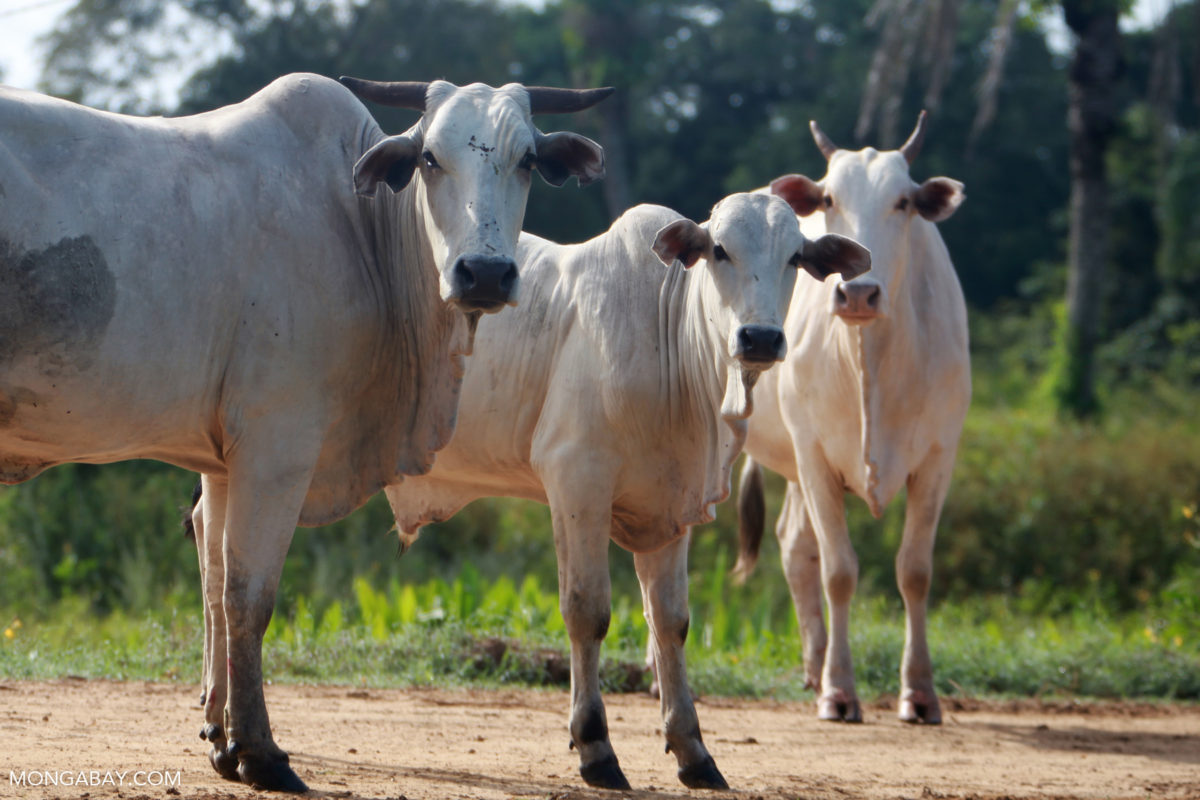
Since the early 1970s, environmental groups have spent billions of dollars on conservation efforts in the Amazon, but have failed to slow the destruction of its rainforests – the Brazilian Amazon has lost more than 700,000 square kilometers (270,000 square miles) of forest in that time. As donor dollars poured into the region, deforestation rates [Continue reading]