
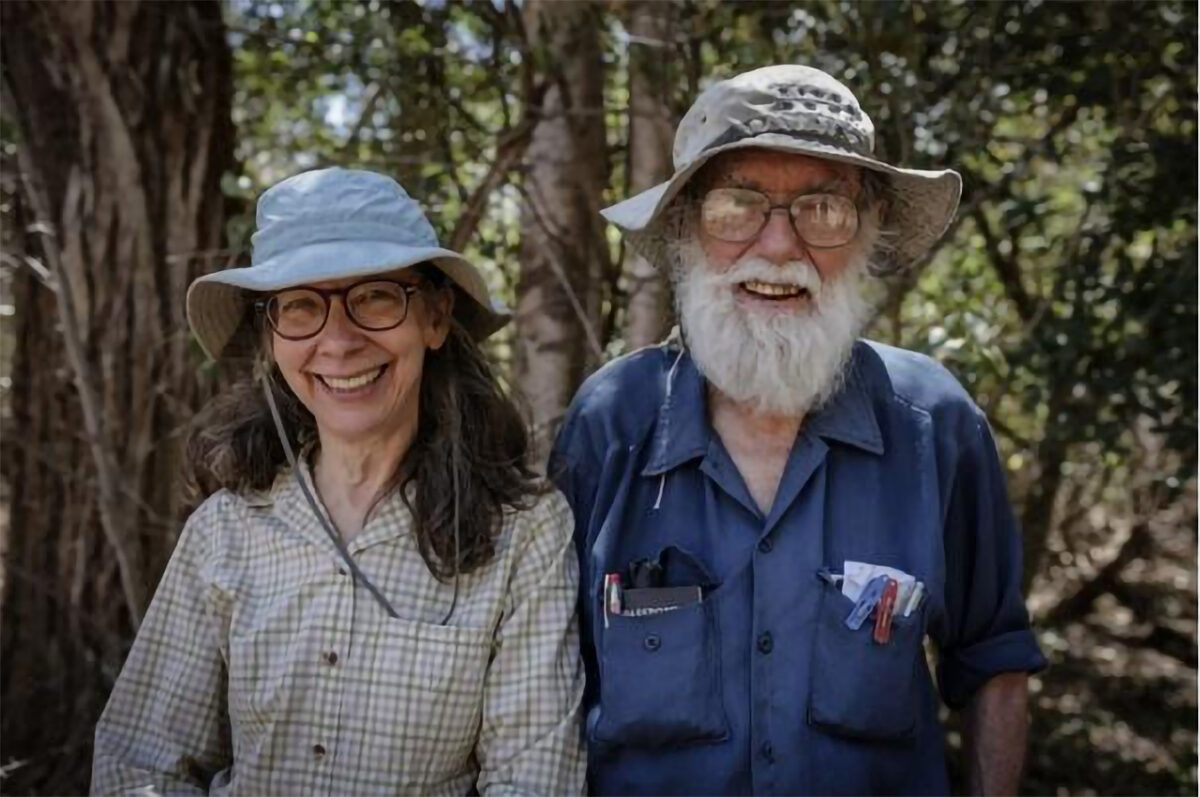
I started working on a piece about Dan Janzen in 2022. I had long known his work, both the scientific and conservation sides. But as I became more aware of how the scope of that work expanded over the course of his career, I came to understand more fully his legacy, as well as the contributions that Winnie Hallwachs, his wife and research partner, has made to it.
That growing understanding made the piece difficult to complete. I would think it was finished, though not quite ready for publication, then encounter something new and return to it. The process played out over nearly four years. Now, I feel ready.
What struck me about Janzen and Hallwachs was how far they evolved from classic ecologists focused on fundamental biological questions. Janzen’s early work included dissecting plant-herbivore interactions, such as the Acacia-ant mutualism; formulating landmark hypotheses, including the Janzen-Connell model and tropical mountain-pass physiology; and gathering meticulous life-history data across Central America. In those years, protected areas often seemed to be viewed chiefly as outdoor laboratories: static settings for research rather than dynamic landscapes under existential threat.

Janzen responded as the circumstances changed. By the late 1970s and early 1980s, rapid deforestation across Central America had made clear that a purely academic documentation effort could soon become a catalog of extinctions. When Janzen and Hallwachs turned their attention to Santa Rosa National Park in Costa Rica, they realized that small, isolated fragments of tropical dry forest—the most endangered major tropical ecosystem in Mesoamerica—would not survive over the long term without intervention to protect and restore the ecosystem at a functional, landscape scale. That realization would culminate in the vision for the Área de Conservación Guanacaste (ACG).
As they began the work, they saw the need to ensure that local communities had a role. Janzen and Hallwachs developed a framework of biocultural restoration with three components:
- Process-driven restoration: They recognized that the forest could regenerate if anthropogenic fire was eliminated and pasture grasses were managed. They raised money to buy nearby degraded cattle ranches, creating a corridor that connected lowland areas on the Pacific coast to cloud forests that blanket Costa Rican volcanos.
- The parataxonomist model: They hired local residents, including former cattle ranchers and farm workers, and trained them in taxonomy, fieldwork, and ecology. This challenged the traditional “fortress conservation” model that excluded local people.
- A “use it or lose it” mentality: They argued that protected wildlands must provide tangible value to society. Through the Programa de Educación Biológica (PEB), local primary-school students visited ACG regularly for hands-on ecological education.
By the early 2000s, Janzen and Hallwachs recognized a major bottleneck: traditional taxonomic approaches could not keep pace with the hundreds of thousands of insects they were rearing. Cryptic species were everywhere. They embraced DNA barcoding and integrated it into their daily fieldwork. The effort yielded numerous species discoveries and eventually culminated in BioAlfa, their ambitious national initiative to DNA-barcode every multicellular species in Costa Rica.
To them, barcoding was more than a sequencing technique. It offered a way for a park ranger, farmer, or schoolchild with a handheld scanner to identify a leaf or insect on the spot. In that sense, it could make knowledge of species less confined to specialists and more available in daily life—an idea that underpins bioliteracy, a term coined by Janzen.
Janzen argued that people often move through nature surrounded by organisms they cannot name or distinguish. Barcoding, paired with an online record for each species, could make that diversity easier to recognize: not an anonymous mass of vegetation and insects, but individual organisms with identities, relationships, and places in an ecosystem.


That adaptability also shows up in Janzen’s day-to-day routine. Known for spending 12- to 14-hour days writing and curating biodiversity data, he adapted to the sedentary demands of computational taxonomy by mounting his computer over a treadmill, logging miles while answering correspondence and processing barcodes. It is an approach entirely in character: diagnose the constraint, apply the most direct functional fix, and keep moving.
Here’s the piece: Daniel Janzen and the long work of bringing back a forest
