
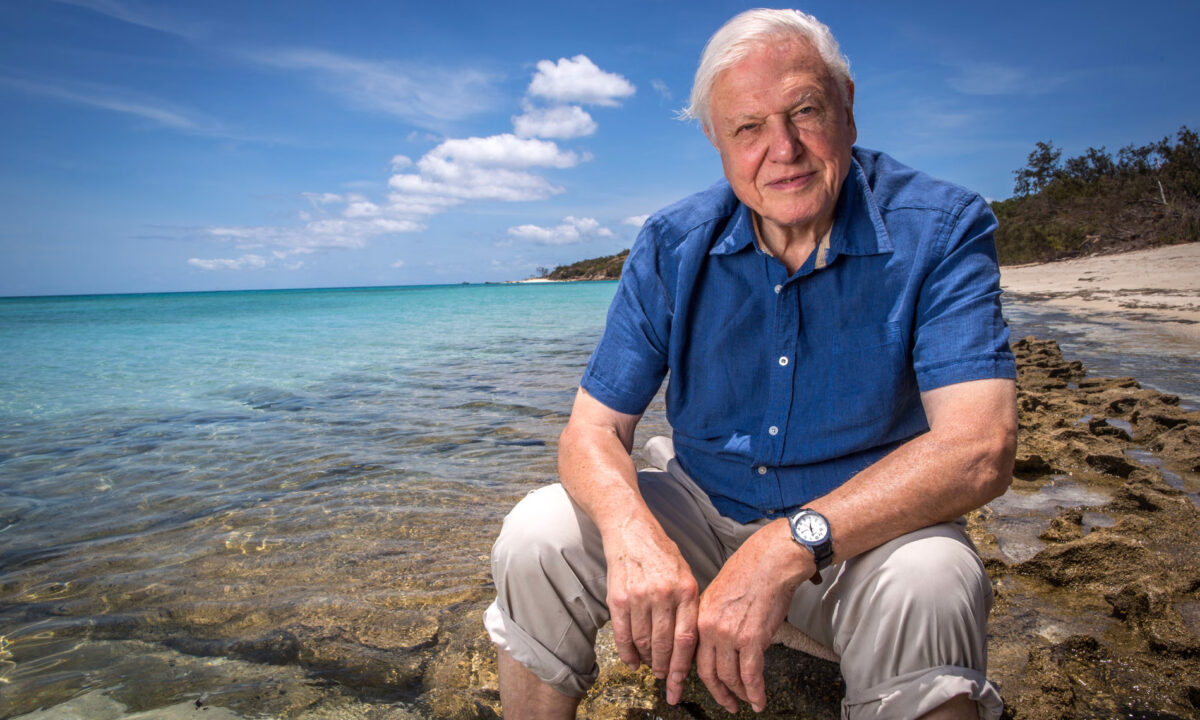
As his 100th birthday approaches, David Attenborough occupies an unusual place in public life: not a practicing scientist, not quite a conventional journalist, and no longer only a broadcaster. His voice has become one of the most recognizable ways the public encounters the living world. That was not always his role.
When Attenborough began at the BBC in the 1950s, the task was simpler. Television was still taking shape, and natural history programming largely meant showing audiences what they could not otherwise see. Early series such as Zoo Quest reflected that aim. They were exploratory and often improvised, driven by the novelty of unfamiliar species. The tone was one of discovery. The natural world was assumed to endure.
As technology advanced so did his approach. Attenborough used these tools with unusual patience. His programs lingered on behavior as much as spectacle. Courtship, feeding, migration: each was given time to unfold. Viewers were asked to notice how animals lived.
This became a defining feature of his work. Understanding, in his telling, begins with careful observation. He rarely placed himself at the center. His narration was measured, often understated, and directed toward the subject. Animals were not props. They were part of systems shaped by pressures, habits, and relationships.
For much of the late 20th century, this method carried a quiet confidence. Series such as Life on Earth presented ecosystems as intricate but resilient. Human impact was acknowledged, though not foregrounded. The prevailing mood was one of admiration.
That balance shifted in the 2000s. Evidence of climate change and biodiversity loss accumulated, and the changes appeared in the very systems he had long documented. Coral reefs bleached. Species became harder to find. Habitats fragmented.
His later work retained its visual discipline, but its framing grew more direct. In Planet Earth II and A Life on Our Planet, the closing segments carried a clearer message. The beauty remained, but so did the strain.
What changed was not only tone, but purpose. Attenborough began to speak more openly about consequences. The loss of species was linked to broader questions about climate and stability. The argument, when he made it, was simple: understanding the natural world is not curiosity alone. It is tied to how societies will fare.
He did not abandon restraint. He avoided exaggeration and simple prescriptions. His conclusions pointed to possibilities—changes in energy use, land management, consumption—without insisting on a single path.
The arc of his work traces a broader shift. What began as an effort to reveal the richness of life on Earth now includes a more sober assessment of its trajectory. The continuity lies in the premise that understanding matters. Not as an end in itself, but as the beginning of responsibility.
The full piece: At 100, David Attenborough’s message is no longer just about wonder
