
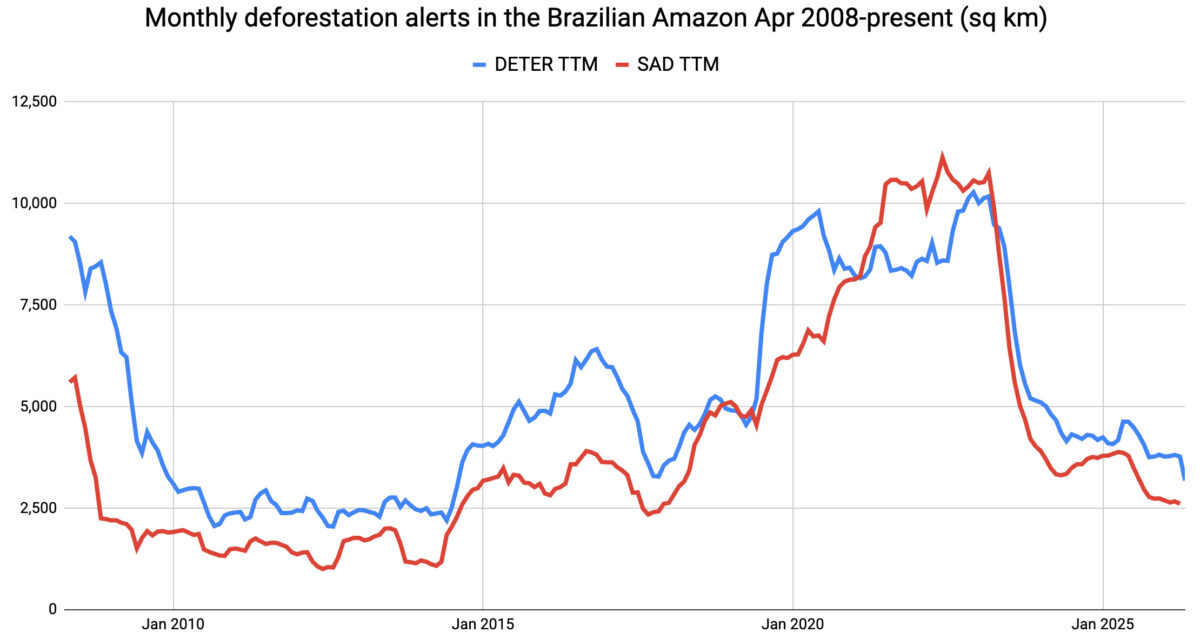
Brazil’s National Institute for Space Research, or INPE, detected 370 square kilometers of deforestation in May through its DETER alert system. That is down from 960 square kilometers in May 2025, a decline of about 61%.
May is an important month in the Amazon deforestation calendar. It often marks the transition toward the drier season, when forest clearing and burning tend to increase across parts of the southern and eastern Amazon. Monthly satellite figures can vary because of cloud cover, timing and the way alerts are processed, but the latest data extend a longer downward trend.
The broader trend is also encouraging. Over the past 12 months, DETER registered 3,182 square kilometers of deforestation in the Brazilian Amazon, down from 4,633 square kilometers during the same period a year earlier. That is the lowest total for any 12-month period in the DETER record dating back to July 2014.
DETER is not Brazil’s official annual deforestation system. That role belongs to PRODES, which produces the government’s yearly deforestation estimate. But DETER is closely watched because it provides rapid alerts that enforcement agencies can use to detect and respond to new forest clearing.
Independent monitoring by Imazon, a Brazilian nonprofit with its own satellite alert system, shows a similar downward pattern. That gives added weight to the signal that forest clearing has continued to fall.
The numbers matter for Brazil’s climate and conservation agenda. The government has pledged to end illegal deforestation by 2030 and falling deforestation gives it and the world stronger evidence that enforcement, municipal agreements, and renewed environmental governance can make a difference.
The warning is that lower clear-cutting does not remove the risk facing the forest. Scientists are forecasting a high likelihood of a strong El Niño this year. El Niño does not usually cause intentional deforestation by itself, but it can make the consequences of forest loss worse.
Hotter, drier conditions make cleared and degraded landscapes more flammable. Fires set for pasture or land management can escape into standing forest, causing damage that may not appear immediately in deforestation statistics.
So the latest data are good news for Earth’s largest rainforest. The dry season will show whether Brazil can keep those gains while also limiting fire and degradation in a hotter year.
Amazon deforestation alerts fall to lowest 12-month level since 2014, show Brazilian data
