
Last year I wrote a piece about how generative AI seemed to be affecting traffic to Mongabay’s news sites. I think it would be useful to provide an update, especially in light of recently unsealed court documents showing that employees at Microsoft and OpenAI had raised concerns that LLMs could eviscerate publishers by reducing traffic and revenue. One Microsoft executive described the use of online content to train AI as potentially “the largest theft of labor in human history.”
In my piece, I noted that Mongabay had seen a sharp rise in visitors from chatbots, particularly ChatGPT, which had become one of our five largest sources of traffic as of December 2025. That remains the case.
I also noted that visitor engagement from chatbot referrals was significantly and consistently higher than average. People arriving from chatbots spend, on average, three times as long on a page as people coming from Google Search. Bounce rates are similar, while views per session and scroll depth are significantly better. Both chatbot and search referrals far outperform our traffic from social media – except for LinkedIn – on these engagement measures. That observation still holds.
My hypothesis at the time was that Mongabay, and perhaps other news outlets, might be better positioned than some other kinds of publishers because they still provide a function that LLMs cannot fill: they are sources of verified and credible information entering the information ecosystem. LLMs can summarize what has already been published, but they typically aren’t attending a village meeting in the Amazon or investigating an illegal mine. Reporters and editors also make choices about what is worth covering, what needs further investigation, and whose voices should be heard. A core value newsrooms offer is accountability: someone is responsible for producing and standing behind that story.
Another big source of AI-driven traffic is Google Discover, Google’s personalized feed that recommends articles based on a user’s interests. From January through July, referrals from Discover to our main news sites rose from 9 million in 2025 to 46 million this year. In some months, Discover now accounts for more than 40% of our referral traffic.
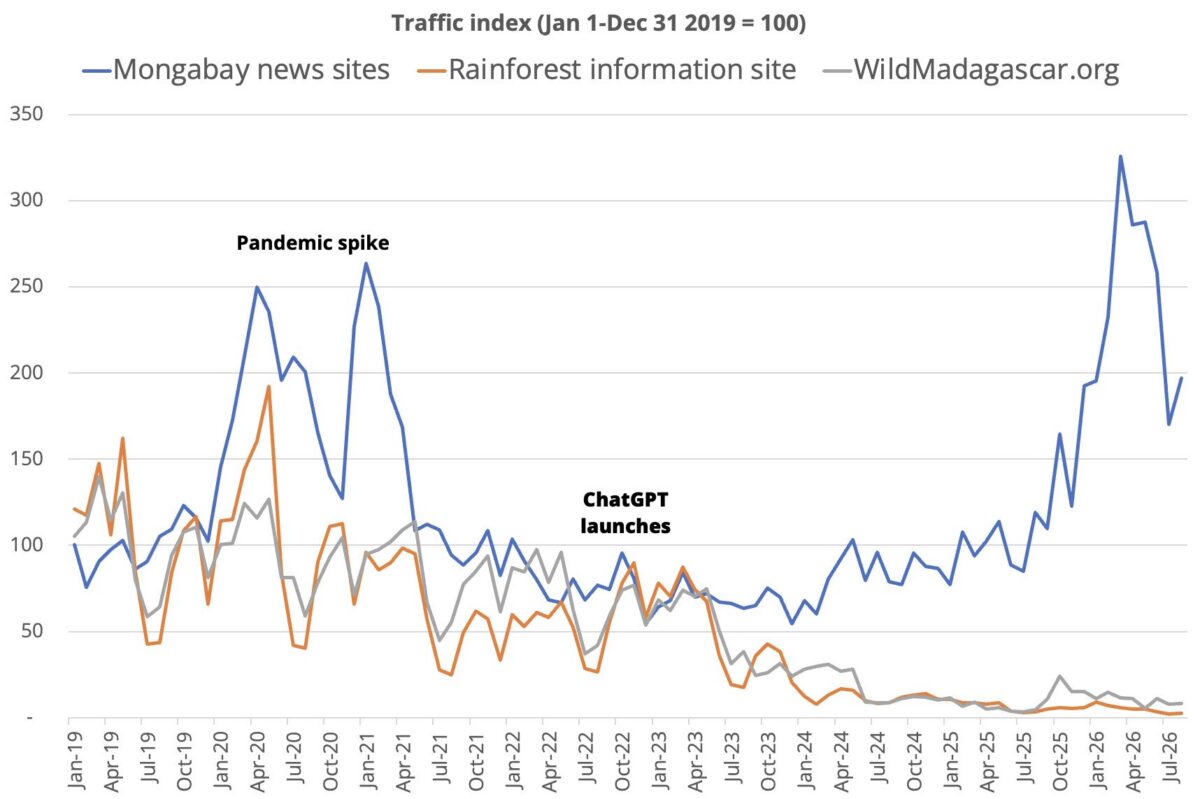
Overall, aggregate traffic to Mongabay’s news sites is up 158% over last year.

But it’s not all unicorns and rainbows. Our evergreen material has been decimated since the launch of ChatGPT in late 2022.
Evergreen “explainer” material is easily distilled by an LLM. I’ve seen a 90% drop in traffic to my rainforest information site (established in 1999), which formed the original basis for Mongabay; a 95% drop at my tropical freshwater fish site (established in 2000); and an 85% drop at WildMadagascar (established in 2004). These sites are effectively dead, and I don’t expect them to come back.
I’m fortunate that I do not rely on these sites for income. I can only imagine how difficult the current operating environment is for authors and publishers producing high-quality, original material.
The concern is what happens as more sites like these disappear. Why would someone spend years building and maintaining a site if people can get the information without ever visiting it? LLMs still need that information to come from somewhere.
