

In 2025, Mongabay reached 111 million unique visitors through our websites, a 46% increase over the previous year. That figure captures direct readership only. It excludes circulation through social media, messaging apps, and republication by more than 100 partner outlets, all of which extend the audience well beyond what web analytics record. Even so, the geographic distribution of those readers offers a picture of where our journalism is being consumed and, relative to population size, where it carries particular weight.
Mongabay does not orient its journalism toward maximizing general-audience traffic. Our reporting is designed to reach specific user groups—practitioners, policymakers, researchers, advocates, journalists, and others whose decisions shape environmental outcomes—rather than the widest possible readership.

Asia and the Americas accounted for the largest shares of readership, each drawing just over 46 million unique visitors. In absolute terms, these two regions dominated Mongabay’s audience. Asia’s total reflects strong readership in countries where environmental pressures are acute and where Mongabay publishes in multiple languages, including Indonesian, Hindi, Bengali, and others. Given Asia’s population of more than four billion, the per capita reach is modest. Yet the scale still matters. Tens of millions of readers in a region that drives much of the world’s land-use change and industrial growth represents a meaningful channel into policy, research, and civil society debates.
The Americas show a different profile. With far fewer people than Asia, the region’s comparable readership implies a higher per capita reach. North and South America together account for under one billion people. Drawing more than 46 million readers means Mongabay reached roughly one in every twenty residents through its websites alone. In countries such as the United States, Brazil, Peru, and Colombia, the site functions as a regular source for practitioners, journalists, and decision-makers working on forests, oceans, and climate policy.
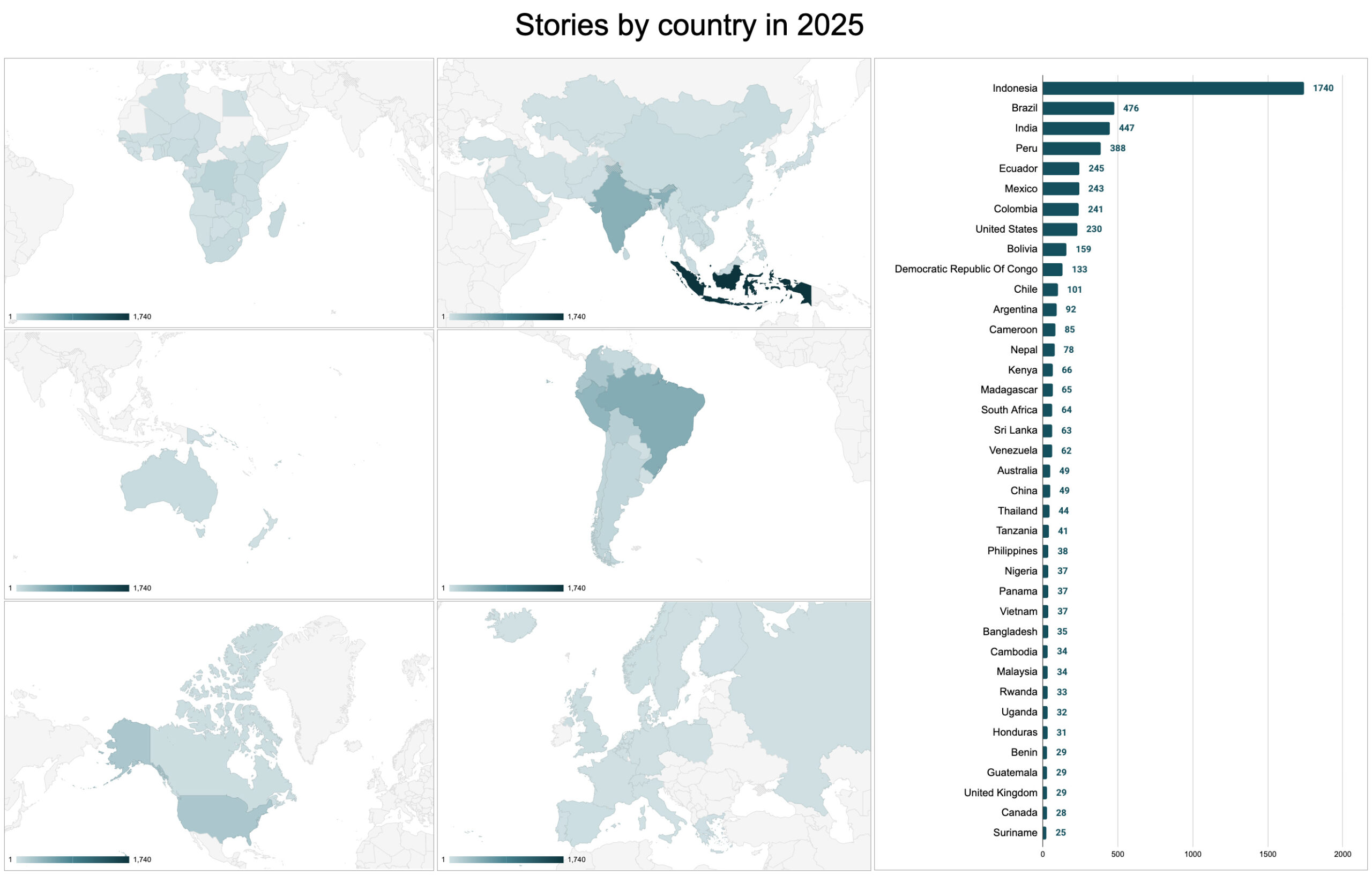
Europe contributed just over 8.4 million unique visitors. This is smaller in absolute terms, but Europe’s population is also smaller and highly saturated with media options. On a per capita basis, Mongabay’s reach in Europe is comparable to, and in some cases higher than, its reach in some countries in Asia. European readers tend to cluster in policy, finance, and advocacy communities, where information flows can translate quickly into regulatory or funding decisions.
Africa recorded about 4.7 million unique visitors. Relative to a population of roughly 1.4 billion, this is the lowest per capita reach of any region. It also highlights a gap. Many of the places most affected by biodiversity loss and climate impacts remain under-served by independent media. Mongabay’s recent expansion in Africa aims to address that imbalance over time.
Oceania, including Australia, had the smallest total audience at 2.6 million, but the highest per capita reach. With a population of roughly 45 million, this implies that around one in seventeen people accessed Mongabay’s reporting directly in 2025. For a specialized environmental outlet, that level of penetration is unusual.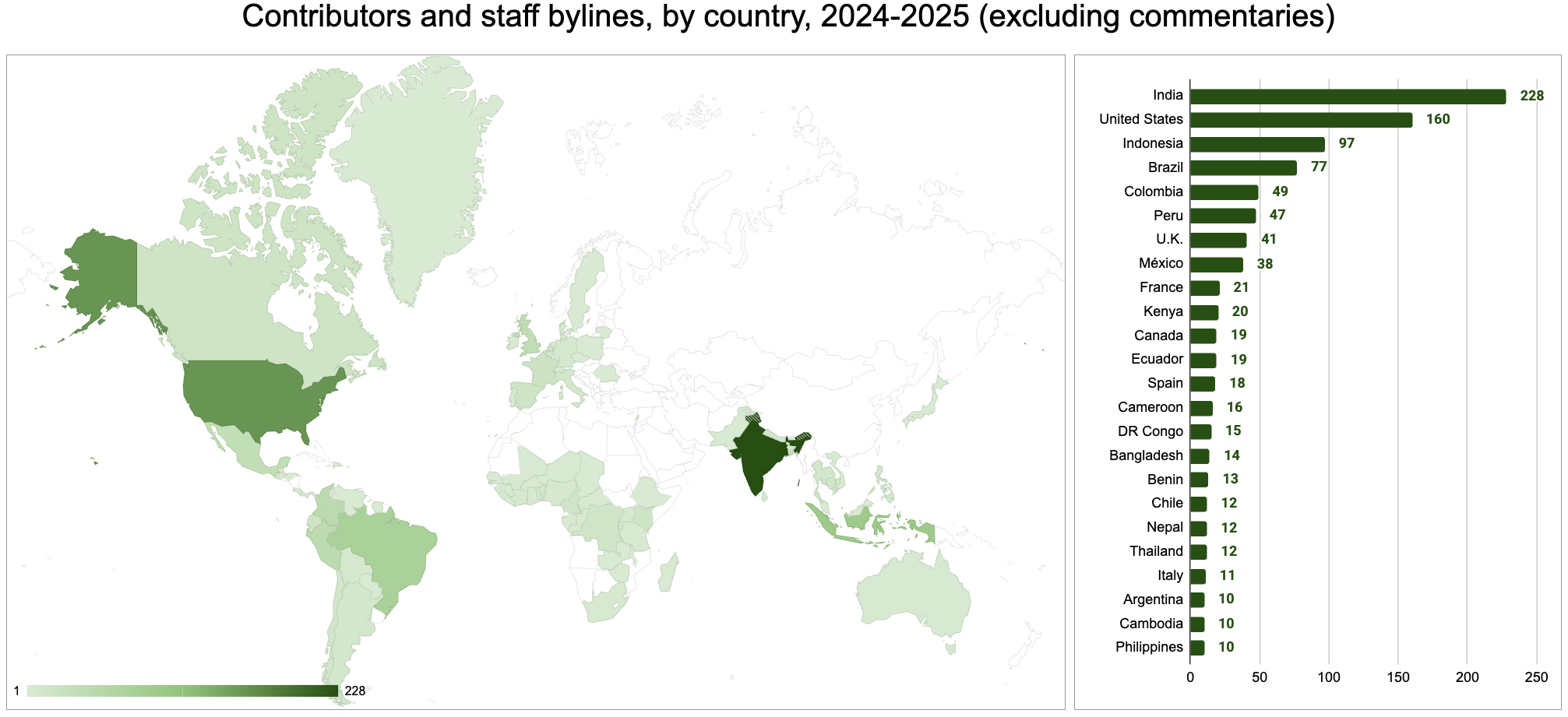
Traffic is not impact by itself. But geography matters. Where readers live shapes who uses the information and how it circulates. In 2025, Mongabay’s readership was global in scale, uneven in distribution, and, in several regions, concentrated among audiences positioned to act on the information they receive.
