

The rate of tropical primary forest loss fell sharply in 2025 after reaching a record high in 2024, but it’s too early for forest advocates to celebrate.
According to new satellite data from the University of Maryland’s GLAD lab, presented by Global Forest Watch, tropical primary forest loss fell 36% from 2024’s record-breaking level. Nevertheless, the world still lost 4.3m hectares of primary rainforest—an area roughly the size of Denmark—and the longer-term trend remains elevated.
That figure is still 46% higher than a decade ago and remains far above the level needed to meet the 2030 target set under the Glasgow Leaders’ Declaration, in which more than 140 countries pledged to halt and reverse forest loss.
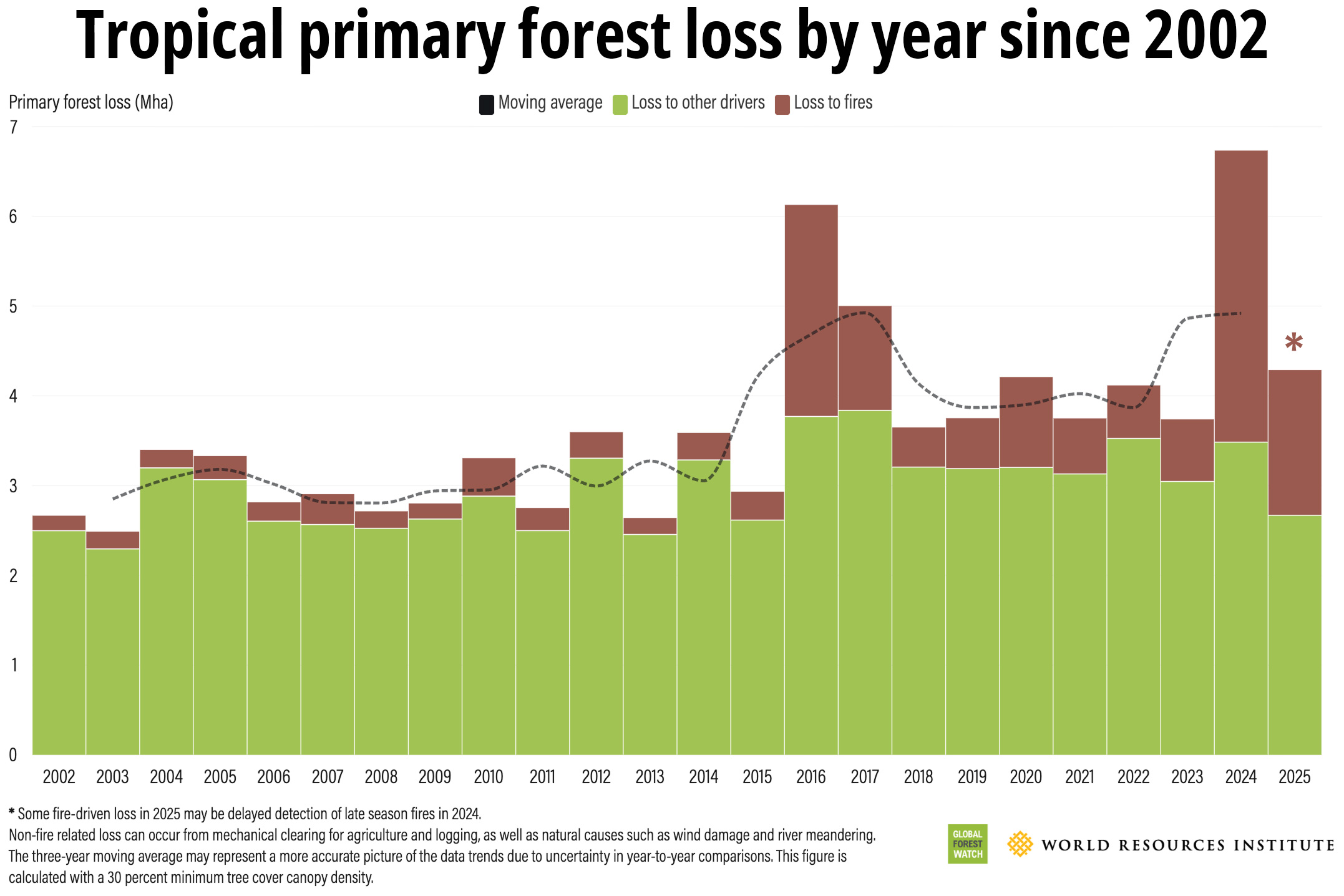

Globally, total tree cover loss reached 25.5m hectares in 2025. Fires accounted for 42% of that total, continuing a pattern in which fire plays a larger role than it did two decades ago.
In the tropics, agriculture continues to drive most forest loss. That includes both large-scale commodity production and smaller-scale clearing for household needs. The analysis also assesses the direct drivers of forest loss, assigning each area of clearing to a dominant cause over time. Within that category, the balance has shifted. The share of tropical primary forest loss—excluding wildfires—linked to shifting agriculture has risen to more than a quarter of loss.
This uptick is largely driven by developments in the Congo Basin. There, people depend heavily on forests for food and fuel, and population growth and migration have pushed small-scale farming further into forested areas. These patterns tend to produce scattered clearing rather than large, continuous areas of loss.


Part of this rise is due to improved detection methods. Advances in satellite data, including the use of newer imagery, now capture small-scale changes that earlier systems often missed. For that reason, long-term comparisons need to be handled carefully. Looking at data since the mid-2010s still shows the Congo Basin contributing to the trend, but less dramatically than when earlier years are included. The driver categories themselves are more representative of dominant patterns over long periods rather than annual shifts.
Brazil drove much of the global decline in 2025. The country cut non-fire primary forest loss by more than 40% compared with 2024, bringing it to the lowest level on record in this dataset. Stronger enforcement and the reactivation of federal anti-deforestation programs appear to have played a central role.
Early data for 2026 suggests the trend has continued. Satellite alerts show that clearing in the Brazilian Amazon has fallen further, reaching its lowest level for this period since 2014.

If this holds, Brazil could record its lowest deforestation rate in the modern monitoring era. Officials attribute the decline to tighter enforcement, coordination with high-deforestation municipalities, and renewed funding for forest protection. Even so, the trend remains vulnerable to economic pressures, infrastructure expansion, climate-related stress, and political will: Brazil faces a presidential election this year.
Elsewhere, the picture is mixed. Colombia reduced primary forest loss, reversing a spike in 2024. Indonesia saw an increase, though levels remain well below their peak a decade ago. Loss in Malaysia remained low. Policies that restrict land clearing and strengthen supply-chain commitments appear to have helped stabilize outcomes in these countries.
In other regions, pressure remains high. Bolivia recorded one of its highest levels of primary forest loss on record after severe fires in 2024. It now ranks second globally for tropical primary forest loss despite having far less forest than the Democratic Republic of the Congo. Much of this loss stems from a combination of fire and agricultural expansion, including cattle and soy.

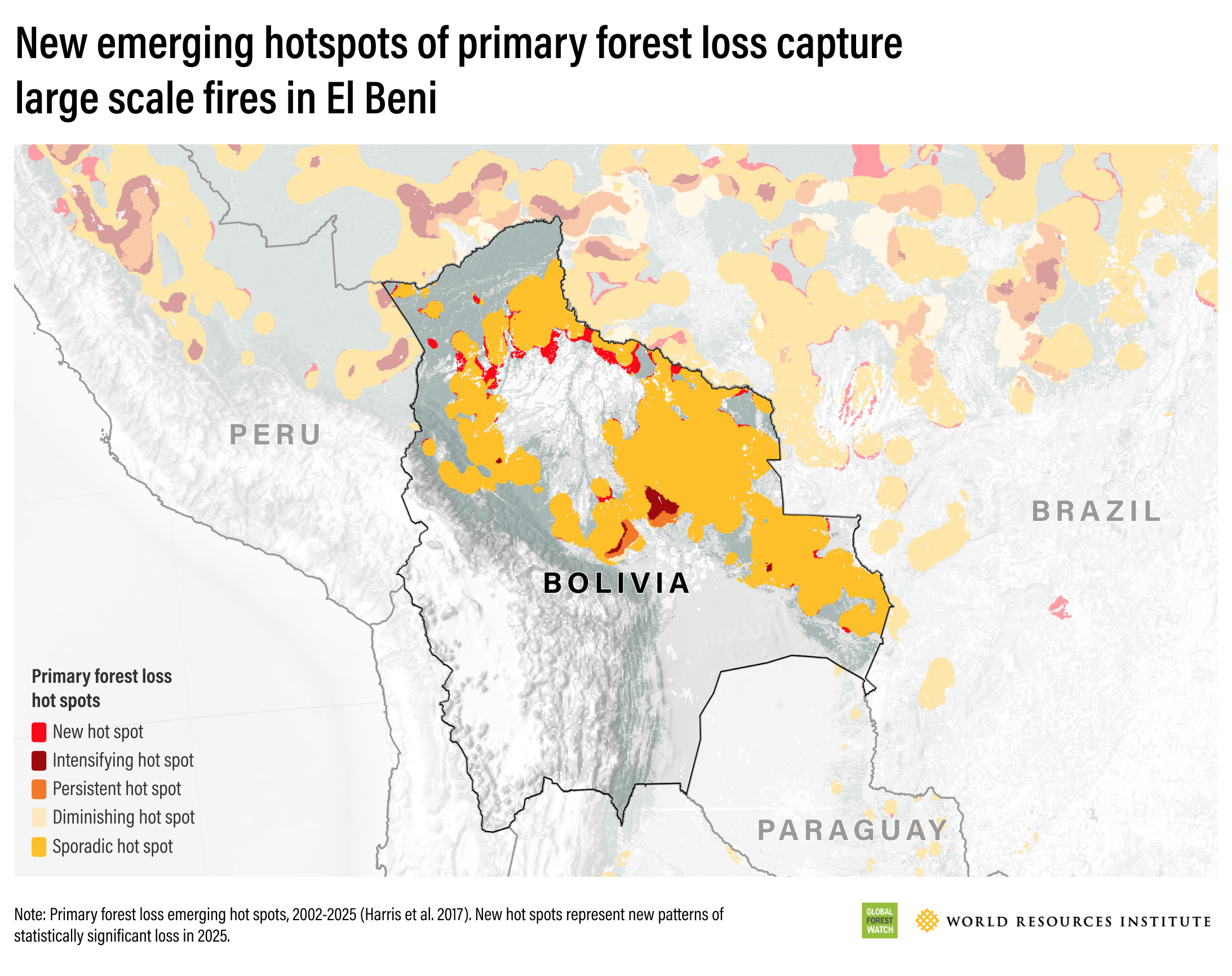
Peru and Laos show similar pressures. Agricultural expansion, mining, and infrastructure development continue to drive clearing, often in overlapping ways.
The Congo Basin stands apart. There, forest loss is tied more closely to subsistence use. In the Democratic Republic of the Congo, non-fire primary forest loss reached a record high in 2025. Small-scale farming, charcoal production, and displacement linked to conflict all contribute to a dispersed pattern of clearing.
Fire adds another layer of complexity. In 2025, fire-driven loss fell from the extreme levels seen in 2024, especially in the tropics, but fires remain a major component of global forest loss. Some of the loss recorded in 2025 reflects late-season fires from 2024 that satellites could not detect at the time due to smoke.
The near-term outlook may depend as much on weather as on policy. Forecasts suggest a high likelihood that El Niño conditions will develop during 2026, with a reasonable chance the event strengthens and persists into early 2027.
El Niño typically brings drier conditions to Southeast Asia and parts of the Amazon. In Indonesia and Malaysia, strong events have triggered large-scale peat and forest fires, sometimes producing major emissions spikes. In the Amazon, El Niño tends to reduce rainfall and extend the dry season, increasing fire risk and placing stress on trees.
If those patterns hold, the gains seen in 2025 could face a more difficult test. Brazil’s recent decline in deforestation, for example, has coincided with relatively favorable conditions. A longer and more intense dry season could increase fire risk across the basin, particularly in already degraded areas.
The Congo Basin is less directly affected by El Niño, though localized drying can still increase vulnerability in fragmented forests. In those areas, even modest shifts in rainfall can influence patterns of farming and fuel use.
As always, there is a danger in reading too much into a single year of data. The drop in 2025 reflects both policy changes and the easing of an extreme fire year. The underlying drivers—agricultural expansion, local land use needs, and climate variability—have not changed much.
What has changed is the balance between them. Large-scale commodity expansion remains central in some regions, while smaller-scale clearing is becoming more prominent in others. At the same time, climate conditions are playing a larger role, particularly through their effect on fire.
The improvement in 2025 reflects favorable conditions, not a structural shift. The next drought will show whether recent gains hold.
