
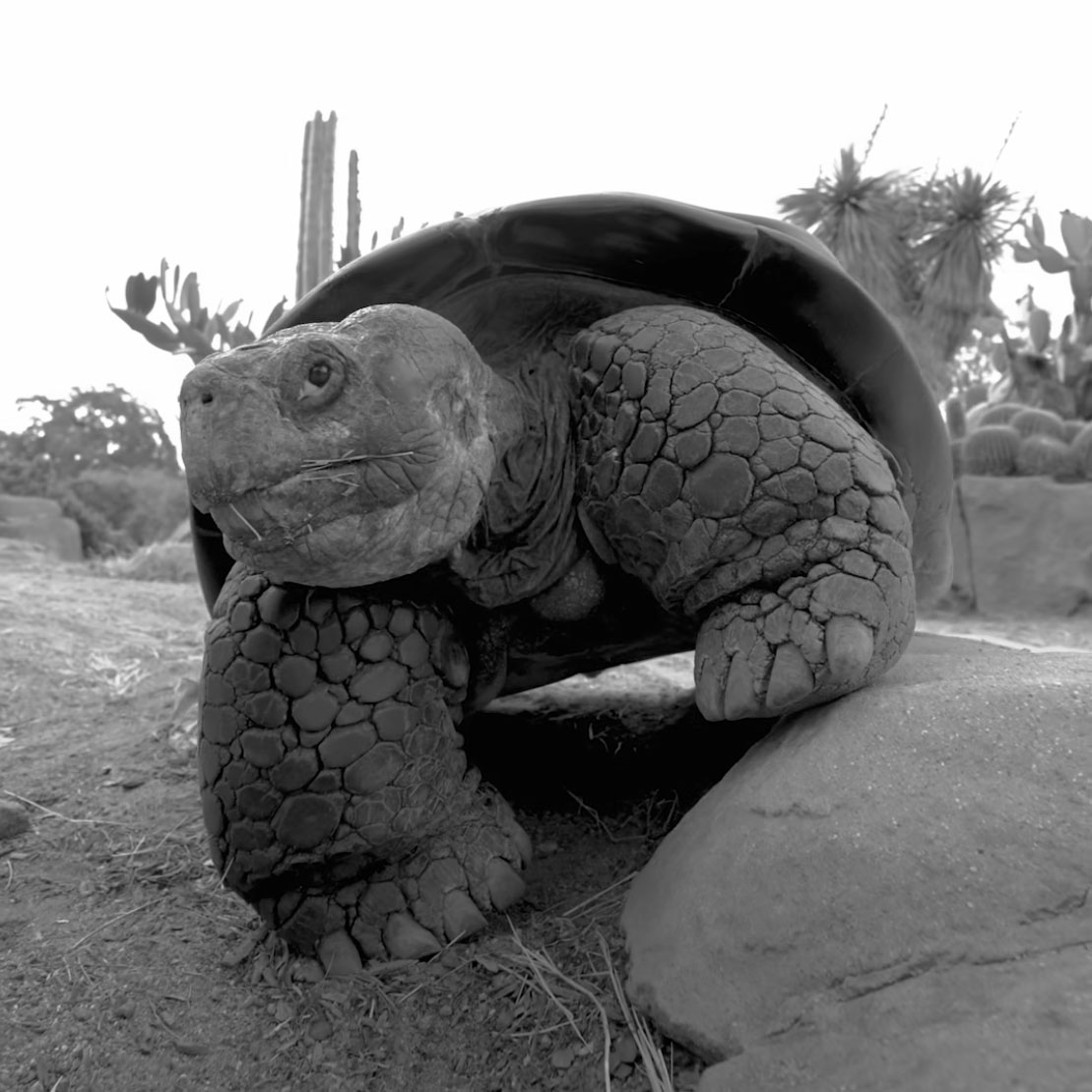
She moved slowly, as if time were something best savored. Visitors leaned over railings or crouched at the edge of her enclosure and watched her stretch her neck toward a leaf of romaine. Children noted she was older than their grandparents. Their parents did the math and realized she was older than the zoo itself. Few likely paused to consider that her life spanned the age of steamships and smartphones, or that she once walked on a very different kind of ground.
Gramma, the Galápagos tortoise, who died recently in San Diego at an estimated 141 years of age, carried with her a past that was not merely long but instructive. She was a survivor of the most destructive century for her kind. When she hatched on one of the islands that gave Charles Darwin his insight into evolution, giant tortoises were still plentiful. Tens of thousands roamed those lava plains. She was born into a landscape already thinned by more than a century of extraction.
To sailors in the 18th and 19th centuries, a tortoise was a barrel of fresh meat in a convenient shape. Crews flipped them over, dragged them across jagged volcanic rock, and stacked them below deck, alive and still for months without food or water. They burned their fat in lamps. They charted coves and springs by the abundance of shells nearby. None among them counted populations or distinguished one island lineage from another; abundance made such care seem unnecessary.
Her own voyage to the mainland was part of that history, though packaged later as conservation or curiosity. Gramma was taken from the Galápagos and arrived first in New York before being sent to California around 1930. The Bronx Zoo then the San Diego Zoo became her world. She rarely saw the island vegetation she once knew. Concrete pathways, fenced lawns, and reliable meals replaced the thorn scrub and distant horizons of home.
Still, she was luckier than most of her species. As she grew heavier and slower in captivity, the islands she left were being remade. When Ecuador claimed the archipelago, settlers brought goats, pigs, and cattle that devoured tortoise food. Rats, dogs, and cats found their eggs and hatchlings. Even where hunting had stopped, newborns could not survive. On some islands, adults lived out their days alone, their subspecies already functionally gone. Three distinct Galápagos tortoise groups have since been declared extinct.
Loss on the islands was not dramatic in any one moment. It built up over time, mostly unnoticed. The disappearance of the oldest animals mattered most. For creatures that may live longer than humans, each matriarch or patriarch holds decades of memory: where to find scarce moisture, when to move upslope for new shoots, which paths avoid the heat. When those elders vanish, they take stability with them. A population may remain, but its wisdom drains away.
Gramma saw hints of this truth in reverse. At the zoo she was treated as the elder she had become. Her caretakers spoke gently to her. Children pointed at her with reverence. During nearly a century in San Diego, she bore witness to shifting human attitudes. She arrived in a time when tortoises were still collected freely for exhibition. She left during a time when zoos speak instead about preservation. In that span, the tortoise went from resource to relic to responsibility.
It is tempting to say she endured everything. But even a century and a half is not enough distance to escape what happened before she was named “the Queen of the Zoo.” She embodied a contradiction: an icon cherished precisely because her kind had been so diminished. Her presence in California was both a triumph and a warning. Survival, after all, doesn’t guarantee safety.
Her death invites the sort of reflection that obituaries try to capture. Gramma was not the oldest tortoise, nor the most famous. She did not help save a lineage as one enterprising tortoise on Santa Cruz Island did, nor did she become a symbol of solitude like Lonesome George. Instead, she lived long enough for humans to change their minds.
That is no small legacy. Today, more than 10,000 juvenile Galápagos tortoises have been released back into the wild. Invasive goats have been removed from several islands. Scientists now track genetics and guard nesting sites. Some populations are recovering. The work is uneven and sometimes slow, but slow can be its own virtue.
For all their stillness, tortoises are examples of patience outlasting harm. Gramma’s life reminds us that the creatures we nearly lost can become the center of our efforts to make amends. She will not walk again under the sharp Pacific sun or rest beneath the shade of a prickly pear tree. But those who do will inherit a little more protection because she lived, and because people finally learned to care.
Her passing is a quiet thing, as her life was. A heavy shell now rests motionless where once there was the slow scrape of her weight across rocky ground. Yet in the islands she left behind, and in the children who marveled at her years, the future of her ancient line looks slightly brighter than the past she survived.
