
In the desert of northern Mexico, near the town of San Fernando in Tamaulipas, there was once a spring so small it barely deserved a name. It lay in the desert like a mirror dropped in the dust — a clear, turquoise eye through which the earth itself seemed to breathe. In that shallow, turquoise water lived a creature scarcely longer than a man’s thumb, translucent and quick, whose life was bound entirely to that one shimmering source. Megupsilon aporus, the Catarina pupfish, was born, courted, and died within that single pool. When the spring was gone, so was it.
The story is almost too small to tell — a fish, a puddle, and a silence. Yet in its smallness lies a parable. For thousands of years, the Catarina pupfish endured the heat and salt of the desert basin. Its ancestors retreated there as rivers vanished and climates shifted. Evolution had refined it into a master of scarcity: tolerant of heat, salinity, and solitude. It had no predators, no migration routes, no refuge beyond its home. Survival depended on constancy: on the aquifer’s slow and ancient pulse. But constancy, in this century, is an illusion.
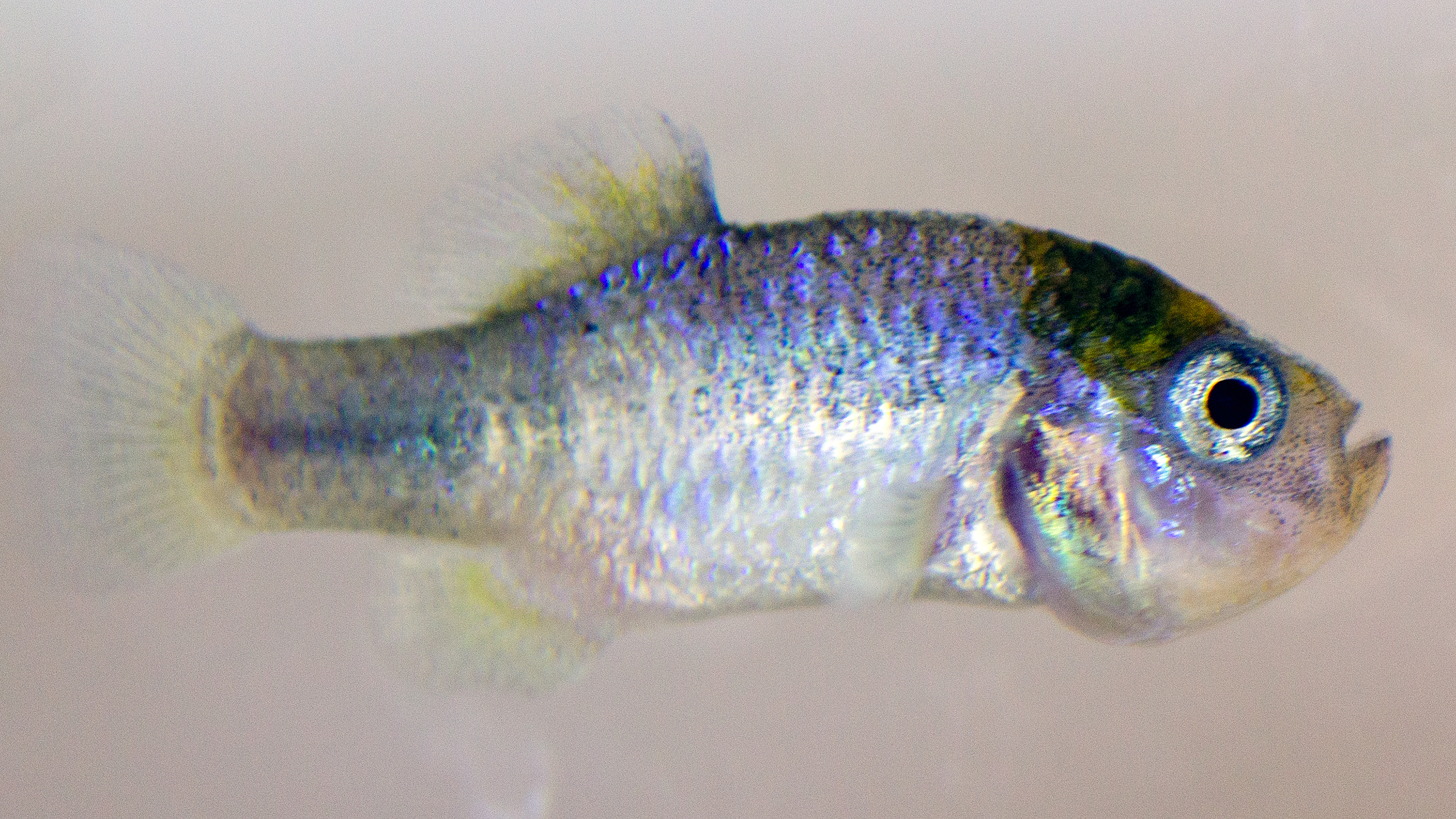
In the 20th century, the land around the spring was parceled and pumped. Wells were drilled to feed crops that would not grow without the water hidden below. Bit by bit, the aquifer fell. The spring shrank, then dried. By 1994, the Catarina pupfish had disappeared from the wild. A few individuals lingered in captivity, kept alive by biologists who recognized their fragility but could not recreate their world. The last of them died in 2014. They left behind no close kin. Megupsilon aporus had no surviving species in its genus. Its family tree ended at a single dot.
In a cathedral of science, this might be read as a prayer for the lost. The priestly symbols would be Petri dishes, glass aquaria, and the hum of filters standing in for organ tones. The faithful — the scientists — kept vigil for decades, nursing each dwindling generation. But the spring did not return. Water, once taken, rarely does. The extinction of the Catarina pupfish was quiet. There were no headlines, no mourning crowds. Only a note in a journal, a name crossed off a list, and the darkening of a tank.
To lose such a being is not only to erase a form of life, but a way of being in the world. The Catarina pupfish asked for nothing beyond the steady rhythm of its spring — no dominion, no expansion, no conquest. Its death, then, is not a tragedy of weakness, but of misfit priorities: a reminder that survival often depends less on strength than on restraint. The earth’s smallest lives hold lessons the mighty have yet to learn.
It is tempting to ask what difference one fish could make. None, perhaps, measurable in trade or comfort. But the world is not held together by its measurable parts. The Catarina pupfish was a note in a symphony now missing a tone. A silence so small that only the attentive will hear it, yet once noticed, it deepens the whole.
If there is redemption, it lies not in resurrection but in remembrance. To recall Megupsilon aporus is to remember that life’s persistence once filled even the driest corners of the map; that beauty can exist entirely unseen; and that abundance is not the same as security. The spring is gone, the water table lowered beyond reach, but somewhere the memory of that glimmering pool endures in the thin thread of empathy that ties the living to the lost.
Requiescat in aqua.
Note: this post was updated with a photograph of Megupsilon aporus in October 2025.
