
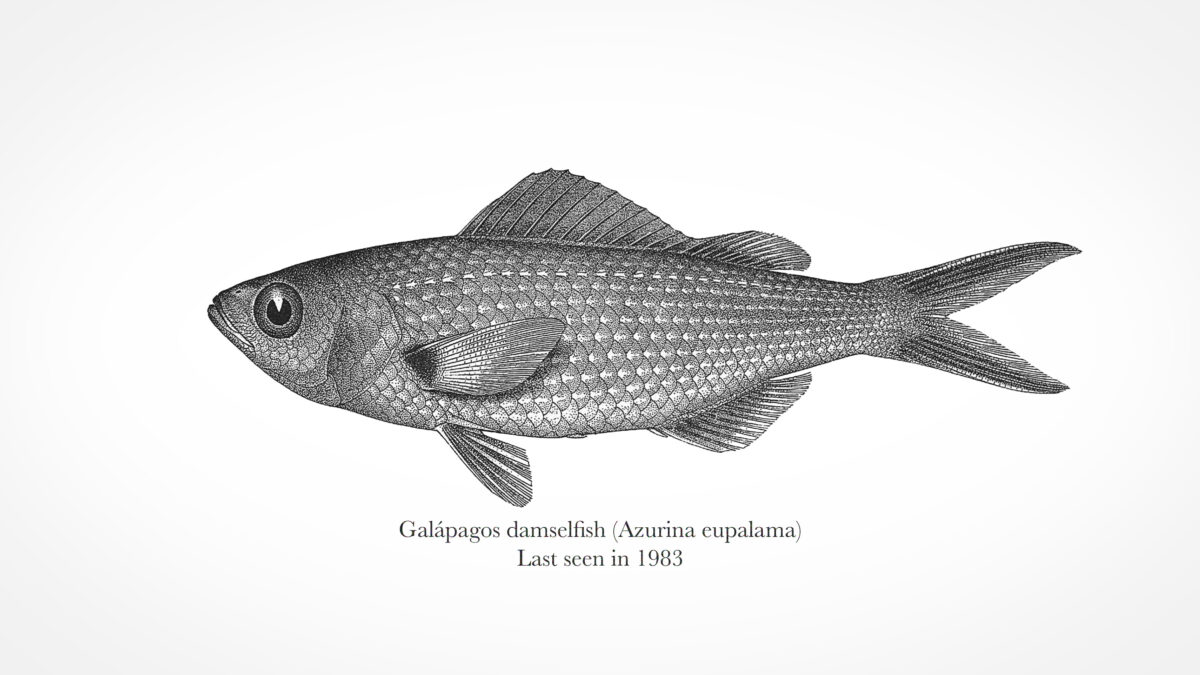
They were described as moving in loose formation along the rocky margins of the Galápagos, holding position where the water deepened and currents carried plankton past. Accounts from divers and early surveys note their presence as steady and unremarkable—part of a system that functioned with enough regularity to make such sightings routine.
The Galápagos damselfish, Azurina eupalama, lived at the edge of a system that depended on timing. Cold water rose. Plankton followed. Life arranged itself accordingly. For decades, the fish appeared wherever those conditions held—collected, recorded, and noted without much concern for their persistence. They were not rare. They were part of the pattern.
Then the pattern shifted.
In 1982 and 1983, the usual upwelling failed. Warm water spread across the islands and stayed. Productivity fell. What had been a reliable supply thinned and broke. For a species bound to that flow—an obligate planktivore, limited to shallow, exposed shorelines—the change was not gradual. It was immediate, and it lasted.
The last confirmed sighting came in that period. Afterward, there were searches. Many of them. The Galápagos is not an empty place. Divers pass through its waters daily. Scientists return to known sites, sometimes for decades. Expeditions have catalogued what is there and what is new. They have also, by accumulation, marked what is missing. In more than forty years, the damselfish has not been seen again.
Its absence is difficult to soften. The species was visible. It schooled in clear water, at depths that did not conceal it. Before its disappearance, it was encountered regularly, taken by expeditions that otherwise varied widely in purpose and method. That record remains. It is the silence that followed that has grown.
There is, still, a technical caution. Marine fish are not often declared extinct. Their early life drifts. Their ranges can reassemble. A remnant population might persist where observation has not reached. New methods—traces of DNA carried in seawater—may yet return an answer. For now, they have not.
Others looked for it with a different kind of persistence. Godfrey Merlen, who spent much of his life along these coasts, searched into his later years. He did not find it for his death in 2023. The effort continued nonetheless, sustained less by expectation than by habit, and by the knowledge of where the fish had once been.
What remains is not dramatic. No single collapse, no visible threshold. A species that was present across the record, and then not present at all. The system continues. Other fish occupy the same water. The current still turns, though less predictably than before.
It is gone nonetheless. Its absence is visible only to those who look for it.
